
Cybersecurity Compliance Services: What They Cover and How to Choose
Cybersecurity compliance services help your business work out which security rules apply to it, put the required controls in place, and keep the evidence that shows those controls are working. They do not replace an independent audit where one is required, and they are not legal advice. A good provider gets you from “we think we are covered” to “we can show it” without turning your office into a paperwork factory.
This guide is for business leaders in Indianapolis and Central Indiana who have been asked about compliance by a customer, insurer, regulator or board. It explains what an engagement includes, which frameworks commonly come up, what drives the cost, and how to prepare so the work goes faster.
TL;DR
- Compliance services cover scoping, gap analysis, control implementation, policy writing, evidence collection and audit readiness. They are ongoing work, not a one-time project.
- Which rules apply depends on your industry, your customers and the data you hold. Health data, payment cards, government contracts and state privacy laws are the usual triggers.
- Some assessments, such as a SOC 2 report or a formal PCI assessment, must be done by an independent third party. Your provider prepares you for them.
- Price depends on scope, number of users and systems, how mature your security is today, and whether you need continuous monitoring. Expect a provider to quote after an assessment.
- The strongest results come when compliance sits inside day-to-day IT management, so controls stay in place between audits.
Table of Contents
- What cybersecurity compliance services actually are
- Which rules and frameworks may apply to you
- Compliance services, managed security and audits: three different things
- What an engagement typically includes
- What affects the cost
- How to evaluate a provider
- How to prepare before you call
- Perspective: why compliance belongs inside IT management
- How Curetopia Networks supports compliance work
- FAQ
- Sources
What cybersecurity compliance services actually are
Compliance is the work of meeting a defined set of security requirements. Those requirements come from three places: laws and regulations, contracts with customers, and voluntary frameworks your insurer or clients expect you to follow.
A compliance services provider handles the practical side of that work. In plain terms, it does four jobs:
- Figures out what applies to you. Many small and midsize businesses are subject to more than one set of requirements and do not know it.
- Measures where you stand. That means comparing your current setup against each requirement.
- Closes the gaps. Technical fixes, written policies, staff training and documented procedures.
- Keeps the proof. Logs, screenshots, tickets, training records and reviews that an auditor or customer can examine.
The last job is the one most businesses underestimate. A control that exists but cannot be shown to exist counts for very little in an audit.
Which rules and frameworks may apply to you
There is no single U.S. cybersecurity law that covers every business. Instead, requirements stack up depending on what you do. The list below covers the ones that come up most often for Indiana organizations.
Industry and data-driven rules
- Health information. The HIPAA Security Rule generally covers health plans, healthcare clearinghouses, qualifying healthcare providers, and business associates that handle electronic protected health information. If you provide services to a medical practice, you may be a business associate even though you are not a clinic.
- Payment cards. PCI DSS applies to merchants, processors, acquirers, issuers, service providers and other entities that store, process or transmit card data, or that can affect its security.
- Government supply chains. According to NIST, businesses selling products to the federal government must meet the FAR 52.204-21 minimum safeguarding requirements, and DFARS may apply to certain Department of Defense suppliers whose products are not commercially available off the shelf.
- Other laws. NIST’s list for manufacturers also names ITAR, Sarbanes-Oxley, state privacy laws, COPPA, the FTC Act and GDPR as requirements that may apply depending on the business.
Indiana also has its own breach notification obligations. Our guide to the Indiana data breach notification law walks through what businesses must do after an incident.
Frameworks that customers and insurers ask for
A framework is not a law, but it is often the practical way to show you take security seriously. The U.S. Chamber of Commerce notes that the CIS controls offer a basic security foundation, with benchmarks divided into basic and advanced levels. That structure suits smaller organizations well, because you can start with the basics and move up as you grow.
Other frameworks you will hear about include NIST-based programs, SOC 2 and ISO 27001. Which one fits depends on who is asking. A manufacturer answering a prime contractor’s questionnaire needs a different answer than an accounting firm answering a client’s vendor review.
A quick way to see what applies
| If you… | Requirements that commonly come up |
|---|---|
| Handle patient or health plan data, or support those who do | HIPAA Security Rule |
| Accept or process card payments | PCI DSS |
| Sell to federal agencies or defense contractors | FAR 52.204-21, DFARS, related NIST guidance |
| Hold personal data of consumers | State privacy and breach laws, FTC Act |
| Serve clients who send vendor security questionnaires | Contract terms, CIS or NIST-aligned controls, sometimes SOC 2 |
This table is a starting point for a conversation, not a legal determination. Your attorney decides what the law requires of you. Your IT provider turns that decision into working controls.
Compliance services, managed security and audits: three different things
Businesses often buy the wrong one because the terms blur together.
Compliance services focus on requirements. They scope, assess, document and prepare you for review.
Managed cybersecurity focuses on protection. It is the monitoring, patching, email filtering, endpoint protection and incident response that keep attackers out day to day.
Independent audits focus on verification. Where a standard calls for an outside assessor, such as a CPA firm for a SOC 2 examination or a qualified assessor for certain PCI assessments, that review cannot be done by the same people who built your controls and called them finished.
The three fit together. Managed security produces the controls and the evidence. Compliance services organize them against a standard. The audit confirms the result. Buying only one leaves a hole: protection without documentation fails the audit, and documentation without real protection fails the first real attack.
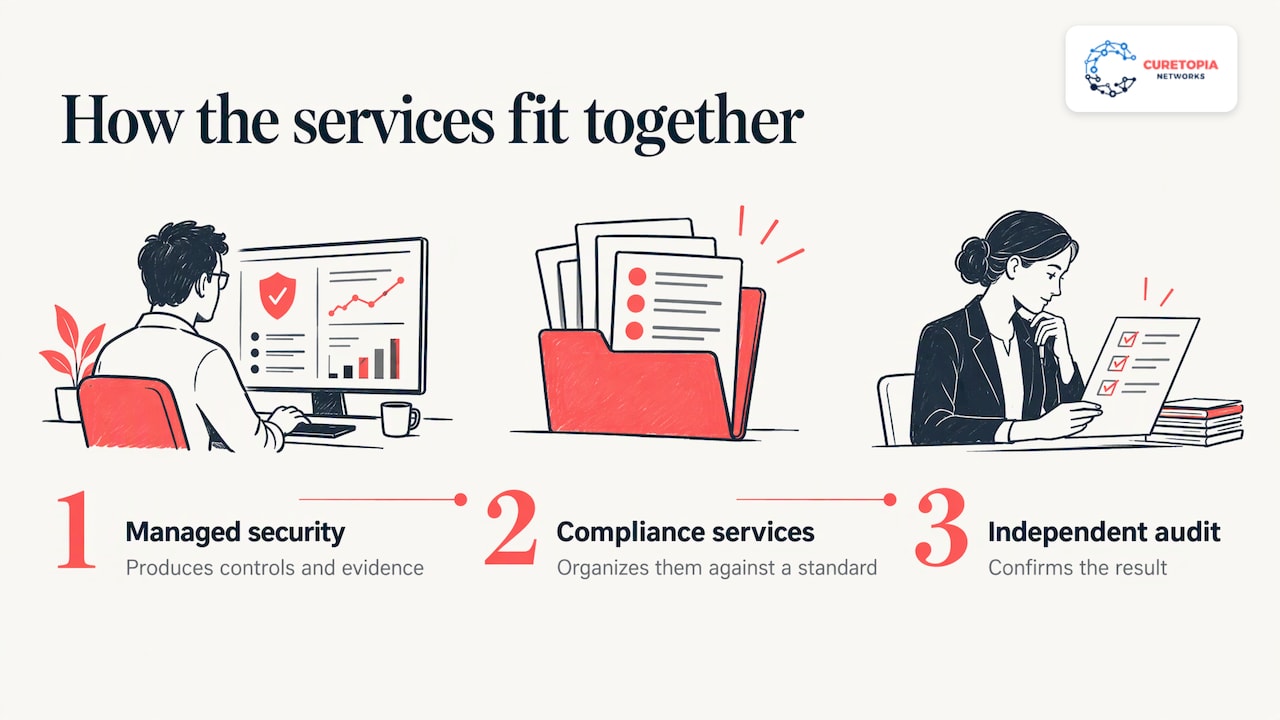
That is why we think of them as one integrated environment rather than three projects. Our cybersecurity services are built around that idea.
What an engagement typically includes
The exact steps vary by framework, but most engagements follow the same arc.
1. Scoping
The provider identifies which systems, locations, users and data types fall under each requirement. Good scoping often shrinks the problem. If card data touches only one system, you may be able to keep the rest of your network out of scope.
2. Gap analysis and risk assessment
The provider compares your current controls to the requirement and ranks the gaps by risk. A risk assessment is the backbone of most frameworks and of HIPAA. Our practical guide to cybersecurity risk assessment explains how it works.
3. Remediation roadmap
You get a prioritized list: what to fix first, what can wait, what each fix involves and who owns it. This is where a strategic IT plan matters. A vCIO and IT consulting relationship helps budget the roadmap across quarters instead of facing one large bill.
4. Control implementation
Typical technical work includes multifactor authentication, endpoint protection, encryption, access reviews, patching schedules, logging, and tested backup and disaster recovery. Most frameworks expect you to prove you can restore data, not only that you back it up.
5. Policies and training
Written policies, an incident response plan, onboarding and offboarding procedures, vendor management and security awareness training. Policies should describe what you actually do. An auditor will compare the two.
6. Evidence collection
The provider gathers and organizes proof: access lists, patch reports, training completion, review sign-offs, test results. Collecting these continuously is far easier than reconstructing a year of activity the week before an audit.
7. Audit readiness and support
Before the outside assessor arrives, a readiness review checks that evidence lines up with each control. During the audit, your provider answers technical questions and supplies documentation.
8. Ongoing monitoring
Compliance is a state you maintain. New employees, new software and new vendors all change your scope. Periodic reviews catch drift before it becomes a finding.
What affects the cost
Compliance providers rarely publish fixed prices, because the work depends heavily on your situation. These are the factors that move a quote up or down:
- Number of requirements. One framework costs less than three overlapping ones, though overlap lets a good provider reuse the same controls and evidence.
- Size of scope. Users, devices, locations, cloud services and applications in scope.
- Starting point. A business with multifactor authentication, current patching and tested backups has fewer gaps to close than one that has never documented anything.
- Depth of support. Advisory only, hands-on implementation, or full ongoing management.
- Audit requirements. Independent assessments are a separate cost paid to the assessor, on top of preparation.
- Tooling. Some programs need additional security software, logging or evidence-tracking tools.
We do not publish a price list, because an honest number needs an assessment first. A short scoping conversation usually reveals whether you need a focused project or an ongoing program.
How to evaluate a provider
Use these questions to compare options. Put them in writing and compare the answers side by side.
- Which frameworks do you work with day to day? Look for experience with the ones that apply to you, not a long list of logos.
- Who does the technical work? Some firms write policies and hand you a to-do list. Others also implement and run the controls. Know which you are buying.
- How do you handle independent audits? A credible provider explains where its role ends and the assessor’s begins.
- What will I receive? Ask for sample deliverables: a gap report format, a roadmap, an evidence index.
- Who is accountable when something fails? Clear ownership matters as much as technical skill.
- How do you protect our data? Your provider will have access to sensitive systems. Ask how that access is controlled, logged and removed.
- Do you know our industry and region? Local knowledge helps with Indiana law, regional insurers and the vendors your peers use.
Software and vendors you rely on are in scope too. If a vendor’s system holds your regulated data, ask where it is hosted and who controls the code. Some organizations look at approaches such as EU-hosted custom operational software to keep data location and ownership clear, and the same questions apply whichever route you take.
How to prepare before you call
The first assessment goes faster and costs less when you bring the basics:
- A list of who is asking. Which customer, insurer, regulator or contract triggered this? Bring the actual questionnaire or clause.
- A rough inventory. Servers, laptops, cloud accounts, line-of-business applications, and the vendors that touch your data.
- A map of sensitive data. Where do health records, card numbers, financial files or personal data live and who can open them?
- Existing documents. Policies, past assessments, insurance applications, network diagrams.
- An internal owner. One person with authority to approve changes and answer questions.
- A realistic timeline. Note any hard deadlines, such as a contract renewal.
If you want a no-obligation starting point, our free IT assessment gives you a view of your current environment.
Perspective: why compliance belongs inside IT management
We see the same pattern in Central Indiana businesses. A customer sends a security questionnaire, someone scrambles for answers, a consultant produces a thick report, and six months later the controls have drifted because nobody owns them day to day.
We think that cycle is the real problem. Compliance treated as an annual event produces annual panic. Compliance treated as a byproduct of well-run IT produces calm audits.
That is why we manage IT as one integrated environment. The same team that patches your systems, secures your Microsoft 365 tenant, tests your backups and plans your technology roadmap also keeps the evidence those activities generate. Controls stay in place because someone is accountable for them every week, not just before an audit.
We also focus on root causes. If the same gap shows up in every review, the answer is not a longer checklist. It is fixing the process that creates the gap.
Our advice: start with scope and risk, build a roadmap you can afford over several quarters, and choose a partner who will still be there to run it.
Cameron
How Curetopia Networks supports compliance work
We provide managed IT and cybersecurity for organizations in Indianapolis and Central Indiana, including professional services firms, nonprofits and manufacturers. For compliance-driven businesses, that means one team handling the security controls, the cloud environment, backup and recovery, and the strategic planning that ties them together. If you already have internal IT staff, co-managed IT lets us fill the gaps instead of replacing your team.
To see how it would work for your organization, start with our managed IT services or talk to us about your specific requirements.
We also publish industry-specific resources, including IT services by industry and a CPA firm IT security checklist, if your sector has particular expectations.
FAQ
Do cybersecurity compliance services replace an audit?
No. They prepare you for one. A provider can scope the work, close gaps and organize evidence, but where a standard requires an independent assessment, an outside qualified party must perform it. Compliance services are also not legal advice, so your attorney should confirm which laws apply to you.
Does a small business really need compliance help?
Often, yes. Requirements follow your data and your contracts, not your headcount. A ten-person firm that handles health records, takes card payments or sells to a government contractor may face the same obligations as a larger one. A scoping conversation will show which apply.
How long does it take to become compliant?
It depends on your starting point and the framework. A business with strong basics may need a focused project, while one starting from scratch will need a phased roadmap. Your provider can give a realistic timeline after the gap analysis.
What is the difference between compliance and security?
Security is the set of protections that keep attackers out. Compliance is proof that you meet a defined standard. You need both: strong protection without documentation is hard to defend in an audit, and documentation without real protection will not stop a breach.
Sources
- NIST MEP: Compliance with Cybersecurity and Privacy Laws and Regulations
- U.S. Chamber of Commerce: Top Business Cybersecurity Standards and Frameworks
- Bitsight: 13 essential cybersecurity frameworks, standards, and regulations